PICS: Pirelli launches new Scorpion tyre
Pirelli has announced that its new gravel tyre - the 'Scorpion', has been approved by the FIA for use in 2008.
This tyre has been developed during several test sessions carried out all over Europe, using a Peugeot 307 WRC car prepared by Bozian Racing and piloted by Italian rally champion Paolo Andreucci.
The gravel tyre has been called 'Scorpion' to 'underline the link between rally tyres and the Pirelli Scorpion road tyres fitted to off-road vehicles and SUVs'.

Pirelli has announced that its new gravel tyre - the 'Scorpion', has been approved by the FIA for use in 2008.
This tyre has been developed during several test sessions carried out all over Europe, using a Peugeot 307 WRC car prepared by Bozian Racing and piloted by Italian rally champion Paolo Andreucci.
The gravel tyre has been called 'Scorpion' to 'underline the link between rally tyres and the Pirelli Scorpion road tyres fitted to off-road vehicles and SUVs'.
"The new WRC gravel tyre from Pirelli is an innovative product that is both robust and environmentally friendly," explained a statement from the Italian tyre manufacturer.
"The 2008 FIA WRC regulations state that anti-deflation mousse cannot be used; so this year's gravel tyre has been considerably strengthened in order to resist cuts, abrasions and punctures from sharp rocks, potholes, and other such obstacles.
"As was the case for the asphalt WRC rubber, the new gravel tyre has been checked by the FIA and the green light has now been given for production of the all-new gravel rally covers to begin."
What follows is some technical details relating to the Pirelli Scorpion gravel tyres:
Gravel WRC tyre - technical notes:
Design
The design has been born out of Pirelli's many years of experience of designing gravel rally tyres. Particular attention has been paid to making the new tyres as adaptable as possible, as they need to perform strongly on hard and compact gravel as well as on mud and loose gravel.
Following several comparison tests an asymmetric and directional design has been chosen, in order to maximise grip under acceleration and braking - as well as providing good lateral grip.
The 2008 regulations state that it will not be possible to introduce cuts or modifications to the Pirelli Scorpion World Rally Championship tyres. This means that the design has been planned from the very beginning to satisfy a very wide and extreme range of requirements.
The depth of the tread pattern has been increased in order to make the tyre last longer, and the diagonal tread blocks have been redesigned. The angle of them now varies from the external part of the tyre shoulder to the internal part, in order to provide a more progressive response through corners.
Construction
The construction of the tyre has been heavily reinforced in order to meet the demands of competition without anti-deflation mousse - which has been completely banned for 2008.
Most of the new reinforcements are based around the sidewalls.
This is the most vulnerable part of the tyre, where it is easy to pick up a laceration or suffer a failure due to sharp rocks or other obstacles at the side of the road.
The new construction uses solutions derived from 'run-flat' technology, which has already been used to good effect by Pirelli on road car tyres.
As well as reducing the risk of punctures to a minimum, these tyres allow the cars that do pick up a puncture to get to the end of the stage without losing too much time and without destroying the bodywork or any other components. The tyre can then simply be changed on the next road section. The materials used to construct the Pirelli Scorpion gravel tyre for the FIA World Rally Championship represent the latest cutting edge technology in terms of strength and lightness, formulated by Pirelli's renowned research and development division.
Compounds
As is the case for the asphalt tyres, there will be just two compounds of the Pirelli Scorpion gravel tyres available, intended to cover all the possible conditions that could be found on the gravel rounds of the FIA WRC next year.
There will be a soft compound, for soft ground or mud - to be used on events such as Great Britain - and a hard compound tyre for rallies with a very abrasive surface, as is the case for a number of events currently on the FIA World Rally Championship.
All these Pirelli tyre compounds also already meet environmental legislation due to come into force from 2010: the use of aromatic oils has been eliminated from the production process entirely.


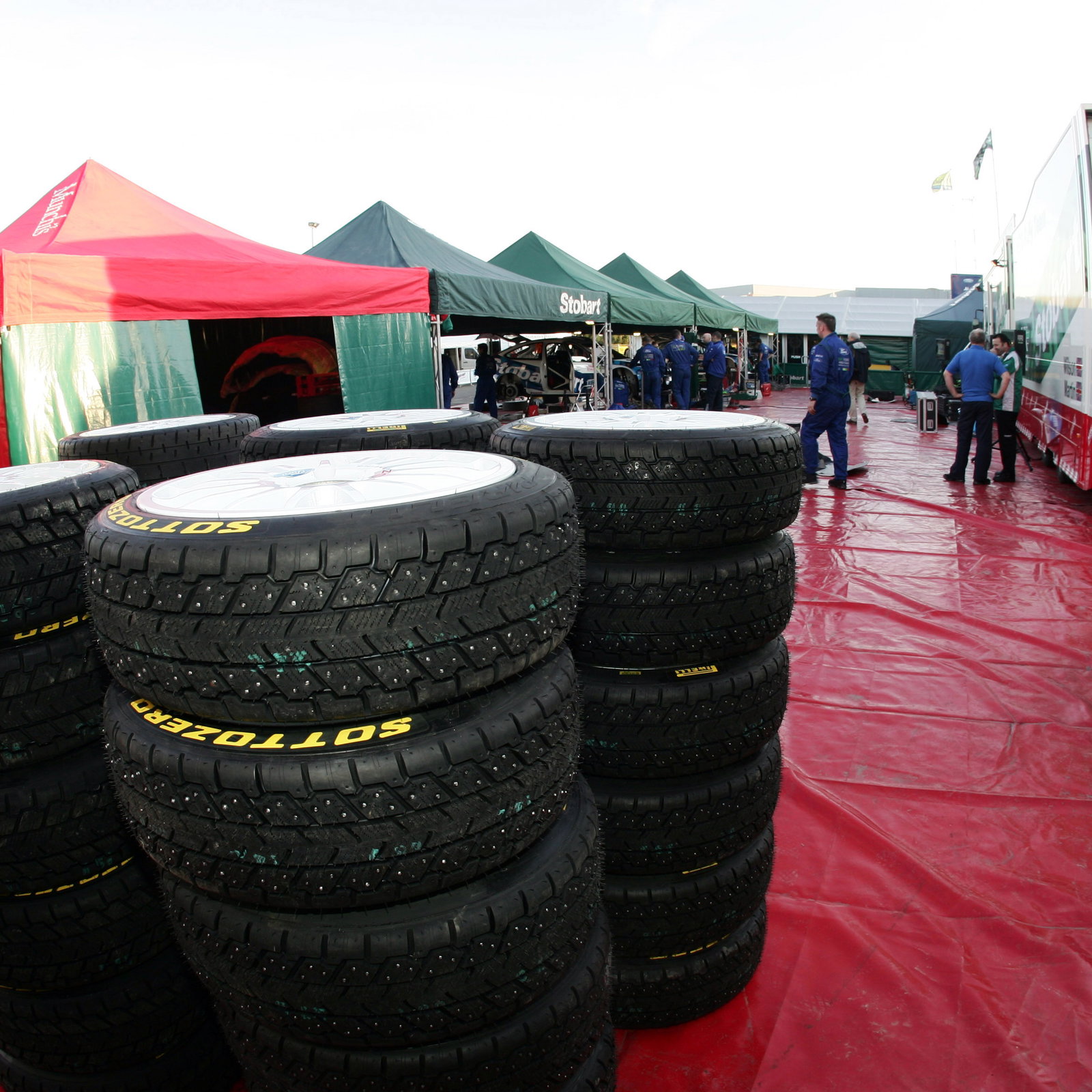
![New Pirelli Sottozero control snow tyre [Pic credit: Pirelli]](https://www.crash.net/sites/default/files/original/crash471085.jpg?aspect_ratio=1:1)