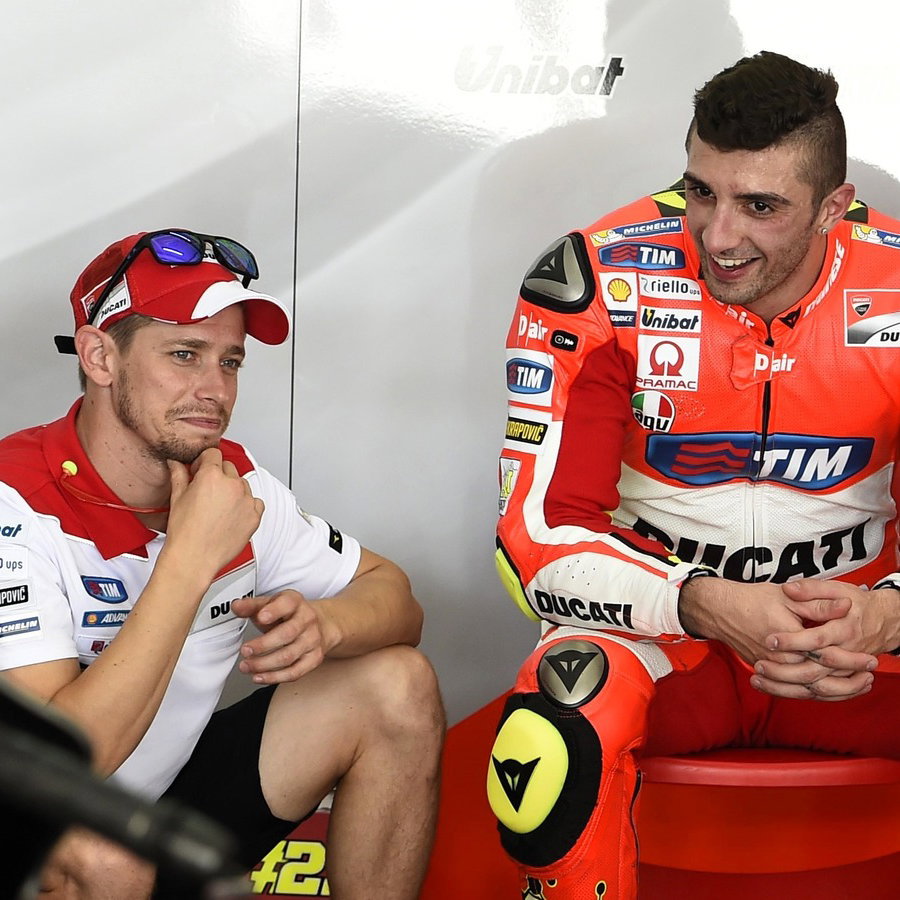
Canepa talks Desmosedici.
2009 MotoGP rookie and former Ducati test rider Niccolo Canepa has provided an insight into riding the Desmosedici grand prix machine, plus a glimpse of life inside the Ducati factory and the challenges he faces in balancing university with MotoGP.
During the past two seasons, Casey Stoner has taken the 800cc Desmosedici to 16 wins, 25 podiums and 14 poles - handing the young Australian the 2007 world championship and second place in the 2008 standings.

2009 MotoGP rookie and former Ducati test rider Niccolo Canepa has provided an insight into riding the Desmosedici grand prix machine, plus a glimpse of life inside the Ducati factory and the challenges he faces in balancing university with MotoGP.
During the past two seasons, Casey Stoner has taken the 800cc Desmosedici to 16 wins, 25 podiums and 14 poles - handing the young Australian the 2007 world championship and second place in the 2008 standings.
But the only non-Stoner victory is a wet/dry win for Loris Capirossi in the 2007 Japanese Grand Prix - while Toni Elias was the next best Ducati rider with two podiums and eleventh overall last year - making the 800cc Desmosedici the most 'mysterious' motorcycle on the MotoGP grid.
Even with the knowledge of computer data and technical understanding learnt as a mechanical engineering student, Canepa admits it is hard to pinpoint exactly how Stoner goes so much faster than every other Desmosedici rider.
"Stoner brakes later and opens the throttle sooner!" smiled the Pramac rider. "I don't know exactly what Stoner does better than us. I know he uses a lot of rear brake, but so does Nicky [Hayden]. When you enter the corner the rear brake helps to close the line."
One area where many GP9 riders are currently losing time is on corner exit, with the rear of the bike 'pumping' up and down as the power is applied. Canepa revealed that it was actually a much bigger problem on the 2008 machine and believes it is caused by opening the throttle too aggressively.
In contrast to suggestions that Stoner's success is down to pinning the throttle and letting the electronics sort it out, Canepa believes that careful use of the throttle is the key to extracting a good lap time from the Desmosedici.
"With the GP9 the pumping is better. With the GP8 it was a big problem," stated the 20-year-old. "With the Ducati you have to be very slow with the throttle, if you open the throttle like this [quickly] the bike starts pumping and you think you are going faster - because the bike moves everywhere - but for the lap time it is not good! It is better to be smooth with the throttle, but it is difficult to get the exact balance right."
Having played a role in development of the GP9 last season, Canepa is already familiar with the new carbon fibre chassis, which he says offers a distinct advantage in a championship where large technical improvements are hard to find.
"There is not a big difference between the GP8 and GP9 - the level in MotoGP is so high it is difficult to find a big gain - but there is a good advantage with the carbon chassis," he explained. "Especially when you enter corners, it is more stable at the front and the GP8 usually wanted to go wide, but the GP9 holds the line. So the new chassis helps you turn and is more stable."
Outside of Ducati's factory race team, Canepa highlighted the efforts of two people for the success of the Desmosedici project.
"Filippo Preziosi [Ducati Corse general manager] is a very, very, very good engineer. It helps everybody to work with him," said Niccolo. "Also test rider Vittoriano Guareschi does a very good job. He is fast and he does a lot of kilometres with strange things on the bike sometimes! I think if the bike is so good it is also thanks to Vittoriano and especially, of course, to Felipe Preziosi."
Canepa, the 2007 FIM Superstock 1000 champion for Ducati, has also worked as a test rider for the factory's road machines.
"I was also the test rider for the standard Ducatis, like the 1098," he said. "I worked a lot with the development team at Ducati and what surprised me is that everybody gets to ride the bike! It is funny, but it is also very important. They want the opinion of a good rider, an engineer, but also a man on the street - everybody!"
Although Canepa never rode a 990cc MotoGP machine, raced between 2003 and 2006, he did test the road version - and set one of several Ducati 'records' with it...
"I did a lot of tests with the Desmosedici RR road bike. I was the first person to crash that bike... also the 1098... and the MotoGP bike with carbon chassis! I have lots of records at Ducati!" he joked.
As well as being Ducati's only home grown grand prix rider this season, Canepa stands out from his peers by balancing university with a MotoGP career.
"I am studying mechanical engineering, but it is very hard to find the time," he confessed. "I am in my second year. I only have time in winter so I'm not sure when I will finish. Now I am testing and then when the racing starts it is impossible I think.
"This winter I went to university every day and then training in the afternoon, but the other guys study in the afternoon. I have to train a lot so I have no time to study. I don't know anybody else racing at this level who is also studying."
And does studying engineering at such a high level provide any advantages on the race track?
"It helps me understand the data, but the main advantage probably comes from speaking with the other engineers about the bike, because we talk the same [technical] 'language'," said the Genova native.
Canepa, often the second fastest Ducati behind Stoner during test sessions last season, finished the first test of 2009, at Sepang, in 15th position and is under no illusions about the challenge ahead.
"I have a lot to learn and it is very difficult. It does not get any more difficult than MotoGP," he said. "At the moment I am also still learning to use a thumb operated rear brake. My foot is too big for a normal brake lever! Size 44. I will also have to learn five circuits this year."
And the most difficult part of MotoGP?
"The other riders!" he smiled.
In this article


Peter has been in the paddock for 20 years and has seen Valentino Rossi come and go. He is at the forefront of the Suzuki exit story and Marc Marquez’s injury issues.