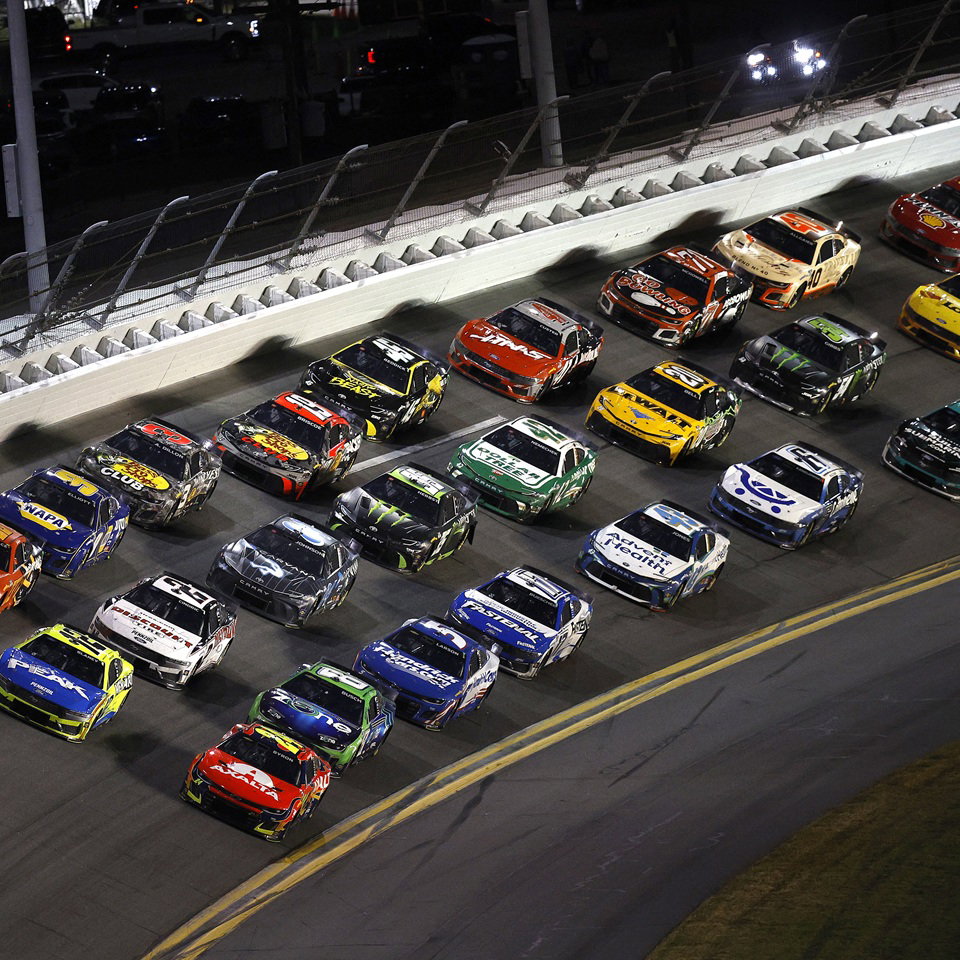
New track drying technology to slash rain delays

With the start of the 2013 NASCAR Sprint Cup season coming up fast with next month's Daytona 500, everyone will be remembering what happened at last year's race: a day and a half late in running due to poor weather, a further in-race rain delay brought the jet driers back out on track and in a bizarre accident Juan Montoya's car spun into the back of one of the machines and ignited its load of aviation fuel in a huge fireball.
Fortunately Montoya and the driver of the jet drier were uninjured, but that incident combined with the more typical frustration of having to wait for hours for a track to be laboriously dried by jet driers after a downpour has spurred NASCAR on to take a new look at how it can dry tracks more efficiently and safely.
"It has always been a difficult thing for our fans, both on television and certainly at the track, that once it rains, how long it takes us to get the track dried again," agreed NASCAR chairman Brian France.
"Let's change the way we do it, let's innovate, let's get a system," France had told his in-house technical development team. "The goal is to improve it by 80 per cent. So that means if we're drying Daytona off, where it usually took two and a half hours, we get it down to 30 minutes. That's the goal. And we're real close."
With the 30-minute target for the two and a half mile Daytona International Speedway, shorter tracks such as the half-mile Martinsville circuit could be ready in just 15 minutes after the rain stops. As well as safer and more efficient, the new process will be more eco-friendly according to France: "We are going to do it in a much more green, carbon-emission friendly way," he said.
The answer to the perennial track drying problem appears to lie in using compressed air rather than the brute force of a jet engine. NASCAR was circumspect about the details as some patents are still going through, but the overall principle seems to echo that of the innovative Dyson Airblade hand-dryers which blast off moisture with a thin concentrated 'edge' of air rather than older driers that use heaters to do most of the work.
"It uses compressed air as opposed to a jet engine," explained NASCAR President Mike Helton. "It's designed to expedite the removal of water using compressed air and heat. Where the jet dryers were simply designed around blowing and depended more on hot air, the new system depends more on compressed air."
"There's a lot more use of vacuums as well," added NASCAR's senior vice president of operations Steve O'Donnell. "It's just different technology."
Helton added that the new driers would vary from their jet counterparts "quite a bit, visually and operationally," although it proved difficult for him to describe their appearance in words: "a gain of pipes behind a pickup truck that the air is being pushed through as opposed to a jet dryer," he offered.
Helton said that it was time for the series to move on from jet driers, originally introduced in 1976 but which were now as outdated as the even older original system of simply continuously running cars around wet tracks, dragging old tyres behind them to help the drying process.
"Someone came along with the jet dryer that expedited it quite a bit and served its purpose for a long period of time," said Helton. "But in today's world with the expectations of getting the show done and getting it on, there was a high priority placed by Brian and the rest of us to come up with a way that we could expedite that.
"The folks at the R&D Center responded to that and came up with ideas, and this one seems to have quite a bit of validity to it."
NASCAR will own the proprietary rights to the technology and could lease out the as-yet unnamed equipment to tracks for race weekends as well as to other motor racing venues and other sporting stadiums. The series has 24 units of the new track-drying system already available and ready to roll for an initial trial deployment at the Daytona 500, although the system will clearly not have been perfected by then.
"We're not there yet. But the progress we've seen [has] been really very promising," said O'Donnell.
"The design work is done, the fabrication work is almost done." NASCAR's vice president of competition Robin Pemberton agreed. "We've had some track testing with it, and it shows a lot of promise.
"It sheets the water right off the surface. It takes a little bit to touch things up afterward, but it takes a good swipe at it the first time by. It's better right out of the box, but we'll keep working on it," he explained. "From what I've seen, it's significantly better", although he said that the preformance would clearly depend on relative humidity and temperature at the location. "But it is better. And we'll chase that all day."
Marcus Smith, the president of race track owners Speedway Motorsports Inc., said that the new technology sounded very promising and that he would love to know more, as it could make a lot of difference to the running of events in future.
"When you have the spotty showers throughout the weekend, it seems like it always happens where you have a window that's gong to be two or three hours to dry the track," said Smith. "You finish drying the track and then in five minutes it starts raining again, that's a big downer."
"Any time we have a rain delay, it's a challenge for our competitors, for our fans," agreed Daytona International Speedway president Joie Chitwood III. "Any opportunity we can have to shorten the window that we're red for rain or wet conditions, that's going to be good for the industry, for sponsors, for fans and for TV.
"We've done a lot of testing [of the new system] here at our racetrack. I hope we don't have to use it, but if we do, I think it's going to improve the experience for everyone involved."