Jack Miller explains MotoGP shift that swung things in V4's favour - Exclusive
Jack Miller explains why Yamaha has gone “all in” on a V4 MotoGP project for 2026.

Jack Miller believes the evolution of Michelin’s rear tyre was the decisive factor that tipped MotoGP’s technical balance in favour of V4 engines.
After running an Inline-powered M1 throughout the modern four-stroke era - and winning eight riders’ titles, most recently with Fabio Quartararo in 2021 - Yamaha will join its rivals by switching to a V4 engine in 2026.
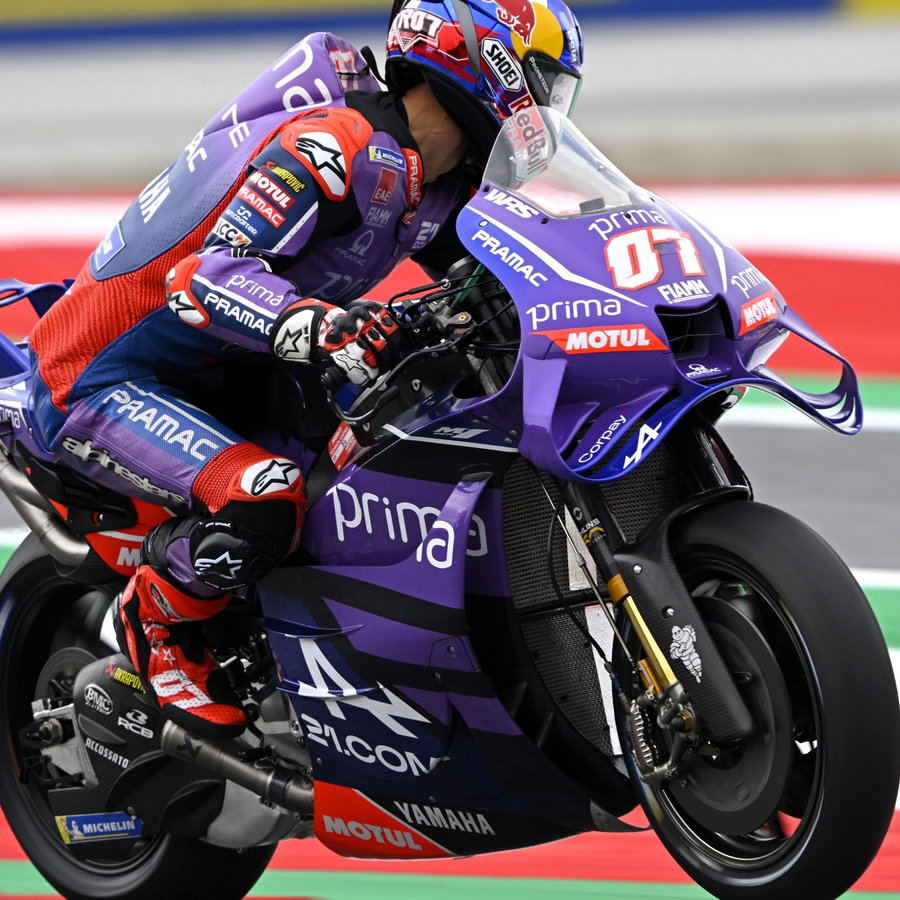
Asked what had swung the balance, Pramac rider Miller - a race winner on Honda and Ducati, then a podium finisher on a KTM - told Crash.net: “The rear tyre. I mean, it's a clear indication.
“The rear tyre changed two-three years ago. It was always sort of leaning that way, the more Michelin developed this rear tyre.
“But to get the outright potential out of the current rear tyre, you need to have the thing on the ground. You need to be using the rear tyre for stopping, mid-corner and acceleration.
“But at the same time, you can't overload it. It’s a narrow working window, but when it's on, it's f**king on!
“If you can extract the full potential out of it, it makes a massive difference.”

That sensitivity also explains why MotoGP form can swing dramatically from one race weekend to another.
“If you can get it in that working window, it's phenomenal,” Miller emphasised. “As you see, at some weekends, some bikes can be ‘on’. And the next weekend they are ‘off’.
“We notice it especially in Yamaha. When the tracks don’t have the best grip or the others can't use the soft rear, we tend to have a better showing.
“Because we're not getting the full benefit out of the soft tyre like the others, we don't notice it [as much] when we’re not using it.
“But the others constantly say they can't stop [without the soft rear tyre] and, from being on the KTM, the feeling was like that.
“When you don't use the soft, you almost feel like somebody's letting the brakes off on you. Because you're not able to use that rear end to stop the bike as much.”

With its V4 decision made, Yamaha now faces the daunting task of trying to beat rivals that have been racing with the technology in MotoGP for at least a decade.
Miller is confident the Iwata manufacturer is up to the challenge.
“Absolutely. And I mean, they've gone all-in on this new project,” he said.
Meanwhile, like all MotoGP manufacturers, Yamaha also needs to develop an 850cc/Pirelli-shod machine for the following 2027 regulations.
“Obviously, the bikes are changing in 2027… but they had to do something. This is [Yamaha] proactively doing something to stay competitive,” Miller said of the V4 move.
“And then, come ‘27, they will have a whole heap more information.
“The Yamaha engineers have been busting their arses for the last 18 months. And they'll continue probably for the next 24!
“But that's the way it goes in this game. It's all a learning process for what's to come in the not-so-distant future.”
That learning process will continue when 2026 MotoGP testing opens with the Sepang Shakedown on January 29-31.
Meanwhile, Quartararo's retirement from the lead of last year's British MotoGP means, for the foreseeable future, the last Inline victory will remain Alex Rins and Suzuki at Valencia 2022.

Peter has been in the paddock for 20 years and has seen Valentino Rossi come and go. He is at the forefront of the Suzuki exit story and Marc Marquez’s injury issues.