Marc Marquez: Ranking all eight of his MotoGP world titles
Ranking all eight of Marc Marquez's MotoGP world titles

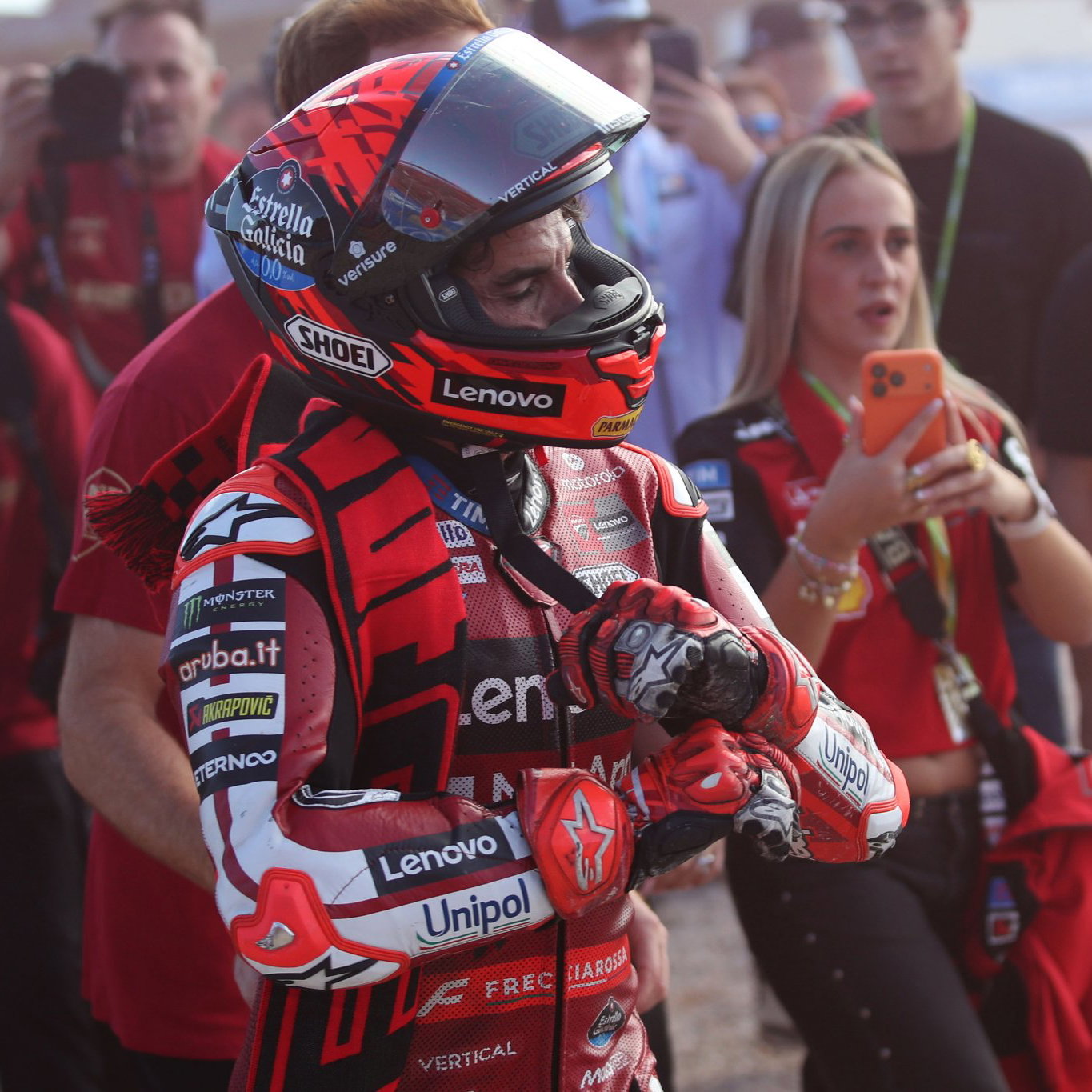
Marc Marquez has become an eight-time MotoGP world championn at the Portuguese Grand Prix.
Securing back-to-back titles for Ducati, his 2026 success came in unlikely fashion, as he battled injury woes to overturn a 102-point deficit in the standings.
Never has a rider come from so far back to win the championship.
But Marquez capitalised on various issues for the once-dominant Aprilia duo of Marco Bezzecchi and Jorge Aprilia.
Marquez, ending a six-year wait last year for his seventh title, now moves into second overall in terms of MotoGP championship wins, level with Giacomo Agostini.
He moves ahead of Valentino Rossi’s tally of seven, while winning the tenth grand prix title across all classes the Italian legend couldn’t achieve in his career.
As Marquez celebrates an historic championship win, Crash ranks all eight of Marquez’s MotoGP title wins.

8. 2017 - Marquez faced stiffest head-to-head title charge in his Honda years
It’s hard to call any world championship win the ‘worst’ of someone’s career, but in the glittering career of Marc Marquez, 2017 was a tough route to premier class glory.
After winning his third MotoGP world title in 2016 on, let's be honest, a below par Honda, there was optimism that Honda would dial out the issues of their 2016 machine and give the No.93 something that would make life easier in 2017, well… That didn’t exactly happen.
The arrival of Maverick Vinales at Yamaha in 2017 was a signal of intent; he was there to take the fight to Marquez and Honda. From pre-season testing and the first two rounds of the season, Vinales blitzed the opposition whilst Marc struggled in Qatar and crashed out of the lead in Argentina.
Vinales cracked in COTA with his own crash, as Marquez took his customary win in Texas to get a well-needed score on the board. But the following rounds for Marc delivered underwhelming results, crashes in Le Mans and an out-of-sorts sixth place at Mugello. A precious second at Catalunya covered up a weekend that saw him crash five times (six if you include him tripping over the starter motor in pit-lane!)
The title charge was still within reach, but it wasn’t Maverick Vinales leading the way. It was someone that wasn’t on Marquez’s radar: it was Ducati’s Andrea Dovizioso. Dovi picked up two wins at Mugello and Catalunya to launch Ducati’s first title charge in a long time.
The stress was taking its toll on Marquez, after his hairdresser realised that his hair was falling out. The approach had to change, and it did, with the reappearance of '2016 Marc', bagging crucial points and podiums as rivals faltered. Using his sixth sense to judge conditions to perfection in Brno, he headed into the summer break as championship leader, with Dovi in hot pursuit.
The title battle would ebb and flow between the two in the second half of the season, with epic battles in Austria and Japan, going the way of Dovizioso and Ducati. It was clear to see that the advantage Ducati had was being cancelled out by the sheer grit and determination of Marquez on the Honda.
Misano proved to be Marquez’s finest win of the season, beating Danilo Petrucci in the wet and setting the fastest lap of the race on the last lap. I suppose that sums up Marc’s 2017 season; it was a season of moments. He wasn’t always the fastest, but when he needed to strike, he did decisively.
The hammer blow came at Phillip Island, Ducati struggled massively, and Dovizioso limped home to 13th place, with Marquez winning in defiant style and being able to control the points gap with two rounds to go.
But the moment of the season comes at Valencia in the final round as Marc takes the lead and produces arguably the most iconic save of his Grand Prix career. It was labelled the ‘Save of the championship’ and a moment that defined the unbelievable talent he possessed.
Six wins, equal with Dovizioso’s tally, show how hard he had to fight for it, and it showed that whilst he might not have been at his best, he was the man for the big moments.

7. 2016 - Marquez triumphs in a new MotoGP era
When people nominate Valentino Rossi as the greatest motorcycle racer of all-time, one of the qualifying factors is often the variety of eras in which Rossi won, or the diversity of the fashion of his title seasons.
Rossi dominated seasons on the best bike, won against the odds on unfancied machinery, won on two-strokes, won on four-strokes, with Honda, with Yamaha, with open tyre rules, with control tyres from one supplier, against teammates, against the old guard, against new blood.
Finding new ways to win is often seen as a sign of superiority.
Perhaps there is no better example of Marc Marquez’s ability to adapt to new circumstances than 2016.
While 2016 saw one of Marquez’s most memorable wins, in Germany, there were only five victories in total that season.
On the other hand, however, there were only four races before he clinched the title in Japan that didn’t feature him in the top three: three of those were top-fives, and the other was a 13th that came after crashing at Le Mans while fighting for the podium with Andrea Dovizioso.
That Le Mans crash was his only fall from a race before he clinched the title in Japan, and even then he picked up three points. This reminds that the most important lesson Marquez learnt in 2015 was that it’s often necessary to consider the risks involved with trying to win.
In 2015, he crashed six times (five were his fault), but in 2016, he did so only twice, and only once before the title was secured.
This improvement in consistency was in contrast to the rest of the field who struggled to string together top results for the whole season – a notably unpredictable one thanks to the introduction of unified electronics and the replacement of Bridgestone by Michelin as sole tyre supplier.
These changes not only complicated things for the riders, but also for the factories, and Honda was one manufacturer that struggled initially.
HRC had decided on a radical overhaul of its engine design – from ‘screamer’ to ‘big bang’ V4 – by the middle of that first year of the new technical rules. The new engine could only be introduced in 2017, though, so the riders had to make do with the hard-to-tame ‘screamer’ until the end of the season.
Plus, Honda had used its factory electronics until the end of 2015, while Ducati had adopted the unified Marelli system already in 2014, and Yamaha began using Marelli’s hardware in the 2015 season.
In all, 2016 was a season that highlighted Marquez’s humility; his crash-strewn run to third place in the 2015 standings left him forced to acknowledge the improvements he had to make to reclaim the crown he’d already won twice in 2016.
He implemented those improvements immediately, and there was no better example in 2016 than his run to second behind Jack Miller at the Dutch TT, a second place that Marquez celebrated as a title – in a way, it was.
The timing of this maturation meant that he was able to win even with a bike that was difficult to master and fundamentally unsuitable to the new regulations.

6. 2018 - Early season pressure gives way to more domination for Marquez
After a final round showdown against Dovizioso and Ducati in 2017, Marquez began 2018 on the back foot with defeat in Qatar and controversy in Argentina following a collision with Valentino Rossi.
But Marquez soon stamped his authority and, from Catalunya onwards, stood on the podium in every race he finished to complete the season a safe 76 points clear of Dovizioso. And he did so while carrying a shoulder injury from a training incident that he kept secret.
The 2018 season was also the year when Marquez’s advantage over his fellow RC213V riders began to balloon.
While Marquez celebrated nine wins and 14 podiums from 18 rounds, LCR’s Cal Crutchlow was closest with a single victory, three rostrums and seventh in the world championship.
Repsol Honda team-mate Dani Pedrosa took a best result of fifth on his way to eleventh in the standings, over 200 points behind Marquez.

5. 2013 - A new legend is born
The 2013 and 2017 seasons saw Marquez have an all-season-long battle for the title.
Between them, 2013 stands out. The first title, as a rookie, always impresses.
Moreover, Jorge Lorenzo, his chief rival for 2013, is putting Marc under immense pressure as they are only separated by four points at the finish in Valencia.
It’s easy to forget that year that Marquez was close to winning the title early, but for a strategy gaffe from Honda leading to him being disqualified from the Australian Grand Prix.
To be pushed to the wire by an experienced champion in Lorenzo would be enough to crumble any rookie. But Marquez proved to be a different class.

4. 2014 - Marquez stretches his legs in sophomore stomp
History was made in 2013 when, as a rookie to the premier class, Marquez clinched a maiden title. Following that up was never going to be easy, but predicting just he would do so was impossible pre-season.
Marquez won 10 grands prix in a row across the first 10 rounds and would score 13 overall - a record - to ease to a second crown.
The 2014 campaign goes hand in hand with 2019 and 2025 for years where Marquez really did have no equal.
Jorge Lorenzo had a bizarre year of woe on the factory Yamaha, while Valentino Rossi needed another season to get into title-fighting shape. Arm pump for Dani Pedrosa led to him suffering an underwhelming campaign too.
But even without all of that, would they really have been able to stop a Marquez beginning to test the limits of his powers?

3. 2025 - Comeback complete
Marquez was at the absolute peak of his powers when he dominated the 2019 world championship and there was no suggestion of that slowing down, even amid a reasonably wobbly winter for Honda at the start of 2020.
With the injury setback, the four major operations and the decision to quit the team he did all of his winning with to accept to ride for free at Gresini in 2024 just to see if he could still be fast, Marquez risked so much to get to where he wanted to be in 2025.
And to then go on and win 11 grands prix, 14 sprints - 10 of those 37-point weekends - and wrap up the championship earlier than he ever has, all while on a still relatively new bike to him in the Ducati, required a level arguably greater than what he showed as a rider in 2019.
No rider in MotoGP history has gone as long between titles, with Marquez now the youngest and the oldest in the modern era to be a champion.
It’s for good reason this is considered one of sport’s best comebacks. Somehow, though, he would manage an even better one.

2. 2019 - Marquez concludes the 2010s seemingly unstoppable
Marc Marquez took his dominance to new heights in 2019, finishing with a staggering 151-point margin over nearest rival Andrea Dovizioso.
Marquez’s 12 victories also dwarfed the two wins apiece by Dovizioso, Maverick Vinales and Alex Rins. The over-exuberance that had cost Marquez dearly in the past was also erased and, COTA aside, he finished first or second in the other 18 races.
Most striking was the gulf between Marquez and the rest of the Honda riders. No other RCV claimed a single win with LCR’s Cal Crutchlow the next best in ninth place, 287 points adrift.
However, the biggest contrast with within the Repsol Honda garage, where triple champion Jorge Lorenzo - tipped to be Marquez’s toughest team-mate - was instead a shocking 19th overall in what would be his final season.
Almost single-handedly, Marquez delivered Honda the triple crown of riders’, teams’ and constructors’ championships and seemed unstoppable… Until Jerez 2020.

1. 2026 - The unlikely title cementing Marquez’s legacy
When Marquez won the 2025 MotoGP world title in dominant fashion, it really did feel like nothing could stop him from successfully defending his crown in the final year of the 1000cc regulations.
But the shoulder injury he suffered in a collision with Marco Bezzecchi at the Indonesian Grand Prix just a week after his title success in Motegi last year threw everything off course. It was clear in the early rounds of 2026 that all was not well with Marquez.
Ducati also hadn’t come to the grid with its best offering, as Aprilia emerged with the best bike. Though there were sprint wins in Brazil and Spain, Marquez couldn’t breach the podium on a Sunday through the first four rounds.
A crash at Le Mans in the sprint which fractured his foot led to the revelation that he’d been battling a nerve issue in his right arm, and that surgery had already been secretly planned for after the Catalan GP.
At the end of his return weekend at Mugello, Marquez was 102 points adrift in the standings. No one in history had ever overturned that kind of deficit to win the title. A week later, Marquez scored his first win of the season in Hungary.
Between Hungary and Germany, he won three grands prix and registered two 37-point weekends to knock his points gap down to 18 by the summer break. Aprilia’s Marco Bezzecchi suffered a stunning unravelling of his own title hopes in this time.
Ultimately, Marquez’s 2026 title success wouldn’t have been possible without Bezzecchi throwing his own shot away. But that’s what happens when Marquez, with a right arm at 50% of its physical capacity, exerts pressure on you.
Jorge Martin found that out, too, in Australia when he crashed and fractured his wrist battling Marquez for the sprint win.
Since he returned at Mugello, Marquez scored in every race and sprint up to his crash in the wet in the Portimao sprint. Neither of his Aprilia rivals managed that consistency. On his strong days, Marquez capitalised, winning seven grands prix and 10 sprints ahead of his coronation in Portugal. Martin, his nearest and toughest opponent, only registered one Sunday win.
Coming to Portugal, Martin needed to outscore Marquez by 24 points to keep the title fight alive. Only once had Martin actually been able to do that in 2026, when he won both races at Le Mans when Marquez crashed in the sprint and withdrew from the grand prix.
The 2026 season may not have been Marquez at his dominant best like in 2025 or 2019. But this was a championship he had no right even being in contention for, let alone winning it in the fashion he did.
To come back once from injury and prevail is extraordinary. But Marquez’s 2026 season and eighth world title, 13 years into his career and physically weaker than ever, was the Spaniard, arguably, at his best.
Tags: